By Abdulsalam Alkali
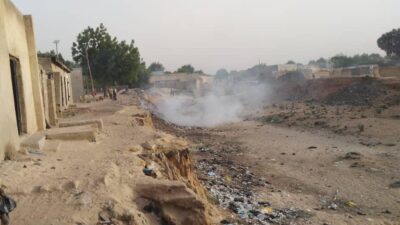
In a quiet corner of old Maiduguri, a community under Jere Local Government area in Borno State, what was once a protective trench has become a growing threat swallowing homes, cutting off accessible roads, and leaving residents stranded with nowhere to turn.
For years, residents say they have lived with a deepening erosion that began as trenches dug by the military during the height of the Boko Haram insurgency. What was intended as a security buffer has gradually transformed into a widening gully, reshaped by years of heavy rainfall and neglect.
Today, that trench is no longer protective. It is destructive. It affects movement, safety, and survival in the community.
From Security Trench to Expanding Disaster
Residents trace the origin of the erosion to military trenches dug for protection during insurgency attacks.
Over time, they say, continuous rainfall expanded what was meant to be a defensive structure into a dangerous environmental problem.
“This is my house,” says Musa Yakub, standing at the edge of a vast drop where his home once stood. “I lost four rooms, a toilet, and everything when the flood came. Even before that, erosion was already a problem.”
What began as a small trenches now grown into a massive erosion stretching over 15 meters deep in some areas. Entire structures have collapsed, roads have been cut off, and parts of the community are now physically isolated.
The September 2024 flood worsened the situation, accelerating the collapse of soil and widening the gully that now divides the settlement that are meant to be connected.
Daily Life on the Edge
For residents, the erosion is not just a landscape issue, it is a daily risk.
Motorcycles and vehicles can no longer pass through. Movement has become restricted, forcing residents to pass through unstable and unsafe edge to reach their homes.
At 70, Baba Atom Mahir walks the dangerous perimeter every day just to reach his home.
Holding a pack of diclofene tablets, a medicine used to treats pain in the body. He describes the physical toll.
“Every day, I struggle with leg pain,” he says. “But this is the only path to my house. Women and children suffer the same.”
For many families, the erosion has turned routine movement into a calculated risk.
A Settlement Built on Displacement and Fragility
The community is largely made up of displaced families and low-income settlers who moved in search of stability after years of insurgency related displacement in Borno State.
Old Maiduguri, like many peri-urban settlements around the city, expanded rapidly as conflict pushed people out of rural communities. But residents say that growth was not matched with infrastructure planning or environmental protection.
As a result, the settlement now sits on fragile ground both socially and environmentally.
Promises That Never Returned
Residents say government officials visited after the devastating erosion, assessed the damage, and made promises of intervention.
“They brought rice, and that was the end,” Musa Yakub says. “Since then, nothing. No follow-up, no solution.”
As you can see construction of bridge like passerby have been started since last year but only 10% of the work has been conducted’’ says a residents from the background pointing out to an abandoned pedestrian bridge.
What remains, according to residents, is a pattern of temporary relief followed by long-term silence.
For many, the absence of sustained intervention has deepened feelings of abandonment.
“No Political Will”
Some community members believe the crisis indicates deeper governance failures.
“There is no political will,” says Engineer Muhammad Haruna, a resident. “You can see road construction happening in other parts of Maiduguri. This community is not visible. That is why no one is coming to our aid.”
His frustration signifies a wider concern among residents that development and intervention are uneven, leaving already vulnerable communities further exposed.
Government Silence and Administrative Gaps
Officials from the Borno State Ministry of Environment acknowledge awareness of the erosion but declined to speak on record.
One staff member, who requested anonymity, cited administrative vacuum as a major constraint following the dissolution of the state cabinet.
“Only a commissioner can address issues like this,” the official said. “Right now, there is no one to speak on what the government is doing.”
For residents, this silence translates into uncertainty.
With no clear authority responding publicly, the erosion continues unchecked.
A Landscape That Keeps Expanding
Back in the community, the erosion site continues to expand slowly but steadily.
Each rainfall deepens the gully.
Each collapse brings it closer to homes that remain standing. Residents say they live with constant fear that the next storm could erase more of their community.
“This is not a waterway,” Musa Yakub says quietly. “It was just a small hole. Now, it is taking everything.”
According to the International Centre for Investigative Reporting (ICIR) the crisis persists despite significant ecological funding allocations.
In 2024 alone, Borno State received over ₦816 million from the Ecological Fund, a federal intervention pool designed for environmental challenges like erosion and flooding.
Yet only ₦20 million about 2.45 percent was spent on flood control within the first six months of the year.
Similarly, out of ₦1.65 billion budgeted for such projects, just 1.2 percent was released.
These figures is reveals persistent gap between budgeted intervention and actual implementation on the ground.
A Community on the Edge of Collapse
For families in old Maiduguri, the erosion is no longer just an environmental issue it is an existential one that threaten their home and safety.
Homes have been lost. Movement has been restricted. Daily life has been reshaped by fear of collapse.
The erosion continues to expand, but residents say official response has not matched the urgency of the crisis.
As the ground keeps giving way, one question remains unanswered in the community, how long will it take for this environmental crises to be resolved before it swallow more home and destroy livelihoods.
THIS REPORTS IS SUPPORTED BY HumAngle Foundation UNDER FELLOWSHIP ON STRETHENING COMMUNITY JOURNALISM AND HUMAN RIGHT ADVOCACY IN NORTHERN NIGERIA (SCOJA) SPONSORED BY THE EMBASSY OF THE KINGDOM OF NETHERLANDS IN NIGERIA.