

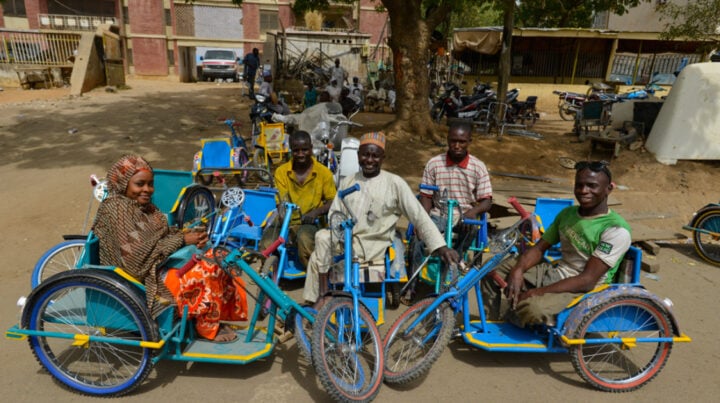
By HUZAIFA ABUBAKAR
At first glance, the newly renovated Fori primary healthcare center in the heart of Maiduguri Metropolis looks like a beacon of progress. It has a ramp. A smooth, grey concrete ramp leading up to the main entrance, a silent nod to the Discrimination Against Persons with Disabilities (Prohibition) Act of 2018.
But for 32-year-old Fatima Modu, who has used a wheelchair for the last decade following a polio infection, that ramp is where the accessibility begins and ends.
“Getting inside is one thing; getting service is another,” Modu says, her voice a calm mix of frustration and resolve. “The ramp takes me to the door, but the consulting room doors are too narrow for my chair. The toilet is a squat style that I cannot use. I have to wait outside while my sister goes in to describe my symptoms to the nurse. I am inside the building, but I am still excluded.”
Modu’s experience is the reality of “accessibility theater” in Borno State, a phenomenon where a single feature, like a ramp, is used to label a building inclusive, while a labyrinth of other barriers remains.
This disconnect between the letter of the law and the reality of daily life for Persons with Disabilities (PWDs) in Maiduguri is stark, and often, it is quantified in inches and degrees.
Accessibility That Stops at the Entrance
Across Nigeria, the presence of ramps at public building entrances is increasingly common, but the reality inside tells a different story. Corridors are narrow, staircases block access to key offices, and essential services are unreachable.
For persons with disabilities, the ramp is a promise unfulfilled — a symbolic gesture that ends where independence should begin. Accessibility stops at the entrance, leaving millions unable to navigate spaces meant for them.
The exclusion is both visible and invisible. While the exterior signals progress, the interior reinforces a harsh truth: public institutions were rarely designed with persons with disabilities in mind. Without functional elevators, wide doorways, or accessible restrooms, independence becomes impossible.
The message is clear, your presence is tolerated, but full participation is denied.
True inclusion demands more than a ramp at the gate. It requires that every step inside be navigable, safe, and designed for dignity. Until public buildings embrace holistic accessibility, persons with disabilities will remain on the margins, visible at the door but invisible within.
The 17.5% City
According to a pivotal 2018 study published in the Bayero Journal of Evidence-Based Physiotherapy, researchers assessed 57 public buildings across Maiduguri, a mix of government secretariats, private hospitals, and educational facilities. Using the Americans with Disability Act (ADA) as a benchmark for accessibility, the results were damning. Only 10 (17.5%) of the buildings were deemed accessible to wheelchair users.
The study found that 84.6% of doorways were too narrow for a standard wheelchair to pass through. Of the few ramps that existed, 53.8% failed to meet the required gradient standards, making them dangerously steep for a user to ascend without assistance.
“The ramp is often an afterthought,” explains Barrister Ibrahim Grema, a Maiduguri-based architect and accessibility consultant. “A developer designs a beautiful building, and at the end, someone says, ‘we need a ramp for disability.’ So, they pour concrete over the stairs.
They don’t consider the slope gradient, the landing space, or the fact that a wheelchair user needs 150cm of clear space to turn around in a restroom.” He pauses. “The National Building Code (2006) has provisions, but they are often vague. We lack the ‘universal design’ mindset that assumes diverse users from the start”.
The Weight of Exclusion
While physical infrastructure fails people like Aisha Modu, another layer of barriers exists for those with sensory disabilities. In a cramped office of the Borno State Chapter of the Joint National Association of Persons with Disabilities (JONAPWD),
38-year-old Buba Kolo, who is deaf, communicates through a sign language interpreter.
Kolo works as a community mobilizer, but his biggest challenge is accessing information during emergencies. He recalls the September 2024 floods that devastated parts of Maiduguri.
“When the water started rising, the announcements were made with van-mounted loudspeakers and radio broadcasts,” Kolo signs, his movements sharp and urgent. “I couldn’t hear them.
My neighbors, who were panicking, didn’t think to alert me in a way I could understand. By the time I saw the water entering my compound, it was too late to save my belongings.”
Kolo’s experience highlights a critical failure in emergency preparedness. While the North East Development Commission (NEDC) has stepped in to provide relief materials—supporting over 700 PWDs with food and non-food items in 2025—the pre-crisis communication infrastructure remains inaccessible.
“Inclusion isn’t just about buildings; it’s about systems,” says Hajja Fatima Abubakar, a social worker with the Samaritan Care and Support Initiative (SACSUI), an NGO operating along Bulumkutu Road. “During the flood, we saw pregnant women with disabilities who couldn’t evacuate because the vehicles provided weren’t equipped to carry them. We are building back, but we must build back inclusively.”
The Cost of Compliance
For business owners, the barriers are often financial. Alhaji Sanda Umar, who owns a bustling two-story shopping complex on Baga Road, installed a ramp at the front of his property five years ago. He thought his job was done. It wasn’t until a wheelchair-using customer complained that he realized the upper floor—housing a popular restaurant—was only reachable via a staircase.
“I looked into installing an elevator, just a small platform lift,” Umar says, rubbing his worry beads. “The quote was over ₦3.5 million. For a small business, that is not a repair; it is a capital investment.
The government gives us tax demands, not tax breaks for doing this.”
This financial burden, coupled with weak enforcement of the Disability Act, means many landlords simply wait until they are forced to comply. The 2018 Act stipulates fines for non-compliant buildings, but enforcement remains sporadic.
“We are advocating for a ‘universal design’ approach,” says Barrister Grema. “It is cheaper to build a wide door from the start than to knock down a wall later. We need to educate our professionals—architects and builders—that accessibility is not a charity; it is good design.”
A Glimmer of Inclusive Hope
Despite the systemic failings, there are signs of change. At a recent stakeholders’ summit organized by the Nigerian Bar Association’s Lawyers with Disabilities Forum (NBA LWDF) in Maiduguri, the focus shifted from sympathy to criminality. The theme, “The Criminality of Disability Discrimination,” pushed law enforcement and policymakers to view the denial of access as a rights violation rather than an inconvenience.
Back at the healthcare center, Fatima Modu has learned to navigate a world not built for her. She waits for her sister to finish the consultation. She has become an accidental activist, gently reminding the facility’s management that a ramp is just the beginning.
“I tell them, ‘You have invited me into your house, but you have locked all the inner doors,'” she says. “I want to go to the bank, to the hospital, to the market like everyone else. I don’t want a special door. I just want the same door.





водопонижение котлована иглофильтрами [url=https://vse-o-vodoponizhenii.ru/]водопонижение котлована иглофильтрами[/url] .