

By Huzaifa Abubakar
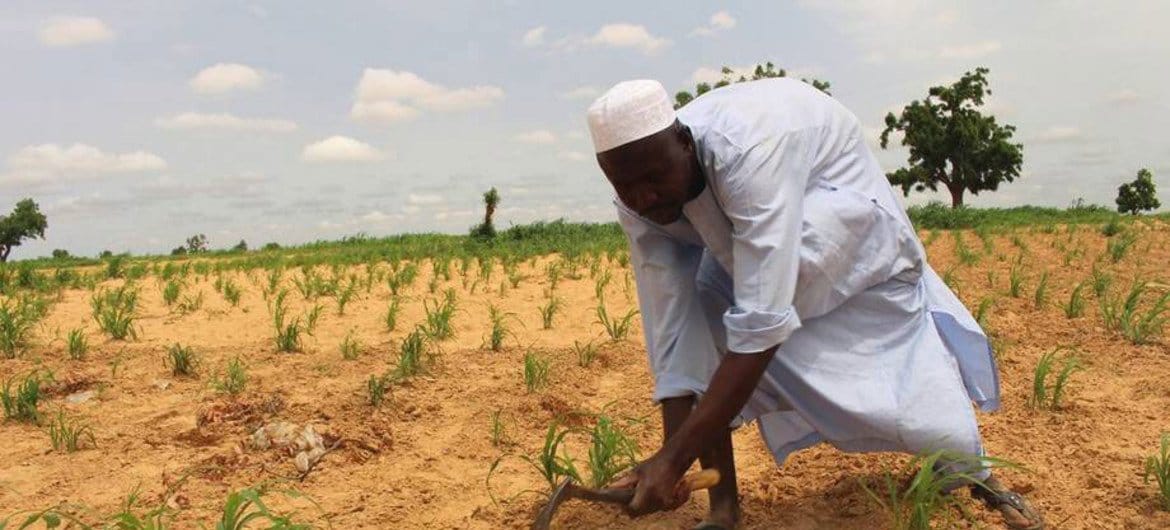
For decades, Musa Abubakar’s family farmed the rich wetlands along the shores of Lake Chad in Borno State. His father grew millet and sorghum; his grandfather fished the lake’s abundant waters. But today, Musa’s farmland lies fallow, overtaken by thorny bushes and dry grass. He hasn’t set foot on it in two years.
“The last time I tried to go, we were ambushed,” the 52-year-old father of four said. “They took my younger brother. We paid N2 million to get him back after three months. I cannot go back. I can not farm. My children have not eaten well in months.”
Musa’s story is not unique.
Across northeastern Nigeria, particularly in Borno State, a brutal combination of insurgency, military restrictions, and economic hardship has forced thousands of farmers to abandon their ancestral lands. The result is a deepening food insecurity and malnutrition crisis that the United Nations warns is the worst in a decade.
A System of Extortion and Fear
The Islamic State West Africa Province (ISWAP) and Boko Haram factions have perfected a system of extortion that targets farmers and fishermen, transforming agriculture from a means of survival into a death sentence.
In February 2026, ISWAP terrorists abducted seven fishermen from the Doron Baga community in Kukawa local government area. The terrorists initially demanded N30 million for their release. After weeks of desperate crowdfunding by families, the ransom was reduced to N15 million. In the end, six fishermen were freed after N6 million was paid. One victim was killed in captivity.
“We first raised N1.8 million through local contributions, but the terrorists’ commander refused to accept the amount,” *Ibrahim. “We had to complete it to N2 million before they released three of our people”.
The commander, identified as Sa’ad, later demanded an additional N4 million for the remaining captives. Families scraped together what they could, selling livestock and borrowing from relatives.
“We do not have the money to pay for the release of our loved ones,” another source said when the initial demand was made. “The terrorists warned that there will be consequences if the ransom was not paid on time”.
This abduction economy has devastated agricultural communities. Farmers now pay “taxes” to insurgents simply to access their fields. Those who refuse or cannot pay face abduction, injury, or death. Those who pay find themselves trapped—extorted by insurgents on one side and restricted by military checkpoints on the other.
Farmers report waiting up to eight hours at military checkpoints when transporting produce. Curfews prevent evening farm work, and access to agricultural land beyond town boundaries requires military permits or armed escorts.
Malnutrition at Critical Levels
The collapse of agricultural production in Borno and surrounding states has triggered a malnutrition crisis of staggering proportions.
According to the October 2025 IPC Acute Malnutrition analysis, nearly 6.4 million children aged 0–59 months across northeastern, northwestern, and north-central Nigeria are suffering from acute malnutrition Of these, 2 million are experiencing Severe Acute Malnutrition (SAM).
The situation is most severe in the northeast, particularly in Borno and Yobe states, where 18 local government areas are classified in IPC Acute Malnutrition Phase 4 (Critical) and 13 in Phase 3 (Serious).
The World Food Programme (WFP) warns that the situation will worsen dramatically. During the peak malnutrition season of May–September 2026, the number of LGAs in Phase 4 is expected to rise from 13 to 33.
“Malnutrition rates across several northern states have worsened too, reaching ‘critical’ levels,” the WFP stated in January 2026.
In Malam Fatori, most families now eat only twice a day—a sharp contrast to life before the conflict. Meals consist of rice or millet, often eaten with little or no vegetables due to cost and limited availability. A kilogram of rice now sells for about 1,200 naira (approximately $0.83), nearly double its previous price.
Fish, once plentiful and affordable thanks to proximity to Lake Chad, has become scarce and expensive. Insecurity, restricted access to fishing areas, and disrupted supply chains have severely reduced local catches. At the local market, women queue before dawn, hoping to secure small quantities of dried fish or maize flour. Many return homes empty-handed.
Food Insecurity by the Numbers
The numbers paint a grim picture. According to the PwC Nigeria Economic Outlook 2026 report, up to 34.7 million Nigerians are projected to face acute food insecurity during the 2026 lean season. This aligns with projections from the UN Food and Agriculture Organization (FAO) based on its October 2025 Cadre Harmonisé analysis.
In the Borno, Adamawa, and Yobe (BAY) states alone, 5.8 million people are likely to face acute food insecurity. Of these, an estimated 15,000 people in Borno State are at risk of catastrophic hunger (IPC Phase 5)—one step away from famine. The WFP describes this as “the worst levels of hunger recorded in a decade”.
“This is a group that’s one step away from famine,” Jean Martin Bauer, director of food security and nutrition analysis at the WFP, said in Geneva in January 2026. He warned that mortality levels in parts of Borno are “way above normal” and said plainly that “people are starving”.
The crisis, Bauer emphasized, is not driven by climate conditions despite a relatively favorable rainy season. “It is driven by violence and severe cuts to humanitarian funding”.
Funding Cuts Compound the Crisis
As needs spiral upward, humanitarian funding is plummeting. In 2026, the Government of Nigeria and humanitarian partners launched an urgent appeal for $516 million to provide lifesaving support to 2.5 million people in the BAY states. This represents a dramatic reduction from the 2025 appeal of $910 million, which targeted 3.6 million people.
The funding situation has already forced cuts. The WFP warns that more than one million people in northeast Nigeria risk being cut off from emergency food and nutrition assistance within weeks unless urgent new funding is received. As a result, and for the first time in Nigeria, WFP’s assistance will be limited to only 72,000 people.
The funding cuts have already had consequences. WFP had to stop assistance to about 300,000 children in Nigeria and may cut support to half a million people in Cameroon due to lack of resources. The WFP urgently requires $129 million to sustain its operations in northeast Nigeria over the next six months. Without this funding, the organization faces the risk of a full operational shutdown in the region. (WFP Report 2025)
Displacement and Agricultural Collapse
Conflict and insecurity have forced over 2 million people to flee their homes in the BAY states. Between January and October 2025, approximately 34,000 people were displaced across the three states, significantly reducing available agricultural labour.
The displacement has devastated agricultural production. Farmers who might have cultivated land now sit in camps, unable to plant. Those who return find their fields degraded, irrigation systems destroyed, and markets inaccessible.
PwC’s report highlights a sharp increase in agricultural input costs as another major constraint on food production. The national average price of NPK fertilizer rose by 19.5% in 2025 to about N52,000 per 50kg bag.
“Production costs increased sharply, with maize and soybean production costs up 29.2% and 36.8%,” the report stated.
Limited access to finance has reduced input usage: only 62% of farmers used agricultural inputs in 2025, down from 81% in 2024, leading to a 24% drop in input application and an 8% contraction in cultivated land.
Hope Amid the Ruins
Despite the overwhelming challenges, some farmers are slowly rebuilding. In Malam Fatori, women have organized themselves into small cooperatives, producing handmade mats and processing groundnut oil for household use and local sale. Fishermen, once central to the local economy, now operate cautiously in small groups in line with security regulations.
Across towns, teams of bricklayers are reconstructing homes destroyed during the violence, using locally sourced materials and shared labour to rebuild shelters for returning families.
However, recovery remains fragile. The FAO has launched its Emergency and Resilience Plan (ERP) 2026-2028 for Nigeria, requiring $347 million to support 12.6 million vulnerable people across the country’s northeast, northwest, and north-central regions. The three-year plan aims to combine rapid agricultural assistance with long-term resilience measures.
“Agriculture is not only a livelihood; it is a life-saving intervention,” said Dr. Hussein Muhammad, Agricultural Economist. “When we support farmers, pastoralists, fishers, and agro-processors with timely inputs, services and market access, we protect food production, reduce dependency on food aid, stabilize local markets and create employment, especially for women and youth”.
For farmers like Musa Abubakar, whose land remains inaccessible, the promise of such interventions seems distant. He away from his first occupation, watching his children grow thinner by the week, waiting for a peace that feels ever more elusive.
“I don’t know when I will farm again,” he said quietly. “But if I cannot farm, how will my children eat? How will they live?”
His question hangs in the air—an indictment of a crisis that has turned farmers into refugees, fields into no-go zones, and a region that once fed itself into one of the world’s most severe food emergencies.





Первичная оценка строится на фактах. Врач коротко уточняет жалобы, длительность употребления, переносимость препаратов и аллергии, фиксирует давление, пульс, сатурацию, при необходимости делает экспресс-ЭКГ и скрининг неврологического статуса. Далее — объясняет на понятном языке логику назначений: зачем именно такая инфузионная схема, какие ощущения нормальны в течение часа и к ночи, как организовать питьевой режим и лёгкое питание «по силам». Мы избегаем «оглушающих» седативов: дозируем узко, чтобы не получить вечернего отката и побочных эффектов. После процедуры повторно оцениваем показатели, выдаём письменные рекомендации, согласуем окно связи и условия повторного визита. Семья получает простые правила поведения дома (тишина, затемнение, ограничение экранов, отсутствие «разборов») и сигналы, когда лучше позвать врача. Итог визита — управляемая ночь и предсказуемое утро, на котором можно строить следующие шаги.
Узнать больше – наркологическая клиника наркологический центр
Кодирование — это медицинский инструмент, который помогает закрепить трезвость, но сам по себе не является «волшебной кнопкой». Его задача — усилить внутреннюю мотивацию и создать физиологические и/или психологические условия, при которых срыв становится маловероятным. В «НаркологЭксперт» кодирование включают в структуру лечения: сначала купируются острые проявления, проводится детокс и стабилизация сна, давления и тревоги, затем — диагностика противопоказаний, подробное информирование, выбор методики и только после этого — сама процедура. Такой порядок снижает риски, повышает переносимость и делает результат предсказуемым. Важно, что любая техника подбирается индивидуально с учётом длительности употребления, анамнеза, сопутствующих заболеваний и рабочей нагрузки пациента, чтобы лечение органично вписалось в реальную жизнь и не сорвалось на первых же неделях.
Подробнее можно узнать тут – kodirovanie-ot-alkogolizma-metody
Мы не составляем «супер-смеси» «на всякий случай». Капельница — это набор модулей, каждый из которых отвечает за конкретную задачу: гидратация, электролиты, гастропротекция, антиоксидантная поддержка; при показаниях — мягкая анксиолитика. Порядок модулей зависит от ведущего симптом-кластера и времени суток.
Углубиться в тему – капельница от запоя
Преимущество
Подробнее тут – вывод из запоя в стационаре
В этой статье собраны факты, которые освещают целый ряд важных вопросов. Мы стремимся предложить читателям четкую, достоверную информацию, которая поможет сформировать собственное мнение и лучше понять сложные аспекты рассматриваемой темы.
Желаете узнать подробности? – https://ording.ct.it/evento/ecomed-2024
Запой — тяжелое состояние, связанное с длительным и бесконтрольным употреблением алкоголя, когда человек не может самостоятельно остановиться. В результате алкогольной интоксикации страдают внутренние органы, нарушается работа сердечно-сосудистой и нервной систем. Чем дольше длится запой, тем выше риск серьезных осложнений. Капельница от запоя — быстрый и надежный способ вывести человека из опасного состояния, снять симптомы интоксикации и восстановить нормальное самочувствие. В наркологической клинике «Перспектива» в Краснодаре вы можете воспользоваться данной услугой круглосуточно, как в стационаре, так и с выездом врача на дом.
Разобраться лучше – капельница от запоя стоимость