

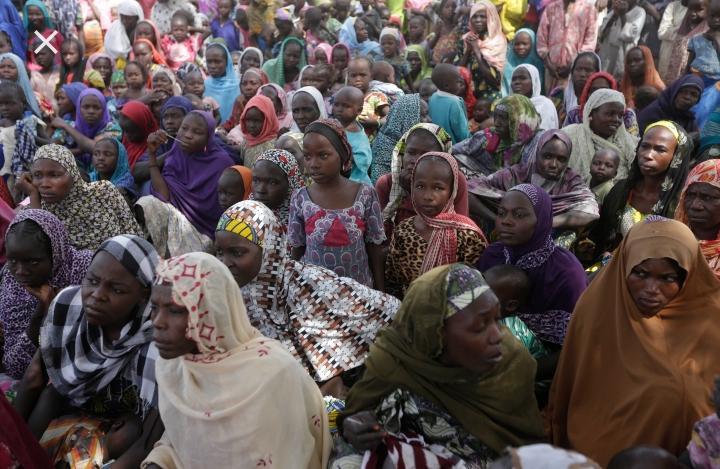
By Saidu Muhammad Tar
Amina sits on a worn mat outside her parent’s house, her four children playing in the red dust nearby. At 26, her eyes carry the weight of someone who has lived multiple lifetimes. She speaks softly, almost in whispers, as if the walls themselves might judge her.
”After nine years, people still do not accept me,” she says, her voice breaking slightly.
“When I go to my hometown, people report me to soldiers. They come to our house and interrogate me. When they discover I am a certified returnee, they apologize and leave.”
Amina is one of numerous other women in northeastern Nigeria who survived captivity during the Boko Haram insurgency. While she has physically returned to society, her journey toward full social reintegration continues, revealing the complex challenges that persist even after rehabilitation programs have concluded.
Her story reflects the experiences of many women navigating the delicate path between survival and acceptance in communities still healing from over a decade of conflict.
The Journey Back
Amina was only 15 when Boko Haram fighters overran her town. The militants destroyed homes, captured residents, and forced young girls into marriages. She spent over two years moving from one location to another before she found a way to escape.
“They married us off,” she recalls, her hands fidgeting with the edge of her wrapper. “The man they married me to stayed with me for only four months before he was killed. After mourning for over four months, they told us women cannot stay without marriage and married us off again.”
The man who became her second husband was also a victim of circumstance—his town destroyed, his father captured, forced into joining the group after fleeing into the bush. When he heard about the amnesty program for those who surrendered, he sent Amina back to Maiduguri while he found his own route to safety.
Amina was five-month pregnant when she reunited home to reunite with her family who welcomed with open hands. Yet the transition back to community life proved more complicated than she anticipated.
“My parents did not treat me bad but the community during the death does,” she explains. “People discriminated against me. I was afraid to mingle because they whispered and pointed at me, saying I was ‘that person.’ Some said I was not mentally stable. People also discriminated against my child.”
For 18-year-old Hassana, the experience reflects similar complexities. Captured during the insurgency and married off to one of her brother’s associates, she managed to return with her husband’s help. Now back in her community, her focus is on education.
“I want to go back to school after returning,” Hassana says simply, her youth evident in her hopeful tone. “I want the government to help us with that.”
Another survivor, 19-year-old Maryam, lost her parents to the insurgency. Her uncle also perished in the violence. Now, she faces barriers to education and livelihood opportunities that require support to overcome.
Aisha, 18, shares a similar narrative. Married off to fighters during her captivity, her three-month marriage ended when she escaped. She gave birth to a boy who later died. Living with her mother and siblings, dependent on her brother’s limited resources, her dreams of education remain unfulfilled.
“I want to go to school, but I do not have the means,” she says quietly.
Community Perspectives
Traditional leaders in affected communities face the delicate task of fostering reconciliation and social cohesion. A community leader describes the ongoing efforts to create an environment of acceptance.
“After the return of these women from captivity, we accepted them wholeheartedly,” the community leader explains. “We were together in the community before the tragedy happened. No one is above trial.”
He acknowledges that while official acceptance exists, changing deeply held social attitudes requires sustained effort.
“There may be a few people who discriminate, but we call their attention and advise them to stop,” he says. “These women are victims. If we do not support them, we do not know what could happen to them.”
The leader describes awareness campaigns conducted with support from international organizations, including training in dialogue and conflict resolution. These initiatives have begun shifting perspectives within communities.
“Some people lacked awareness, but we were able to bring them back to reality,” he added “Thank God the situation has improved.”
The community has also worked to provide shelter and limited livelihood assistance within available resources, demonstrating grassroots efforts toward reintegration.
Legal Protections and Rights
Understanding the legal framework surrounding these women’s situations provides important context for their experiences. Jummai Usman Mshelia, an expert with the National Human Rights Commission in Borno State, explains the protections that exist.
“Any discrimination against them is a violation of their human rights,” Mshelia states. “They are Nigerians, and nobody is supposed to be discriminated against on the basis of race or religion in Nigeria. Everybody is supposed to be treated equally.”
She outlines the legal frameworks designed to protect these women. Under Nigerian law, the Constitution, the National Human Rights Commission Act, the Nigeria Police Act, and the Administration of Criminal Justice Act all provide safeguards.
Internationally, Nigeria is signatory to the Convention on the Elimination of All Forms of Discrimination Against Women, known as CEDAW. The country has also adopted the International Covenant on Civil and Political Rights and the African Charter on Peoples’ Rights, all of which address discrimination against women.
These frameworks establish clear rights for returning women, including the right to dignity, freedom from discrimination, access to education, and social reintegration.
Government Programs and Support
The government has established various programs to support women returning from captivity. Halima Chiroma, Director of Administration at the Ministry of Women Affairs and Social Development, describes the practical initiatives in place.
“We have many programs and policies regarding women returning from captivity,” Chiroma says. She describes three main rehabilitation centers where women receive skills training in bead making, shoe making, snack production, incense making, and tailoring.
“After these women and children return and complete rehabilitation, we engage stakeholders like community leaders,” Chiroma explains. “We conduct sensitization programs so that when these women return to their communities, they are not stigmatized. They should be accepted as part of the community, feel free, and associate with others in society.”
The ministry provides starter kits—tailoring machines, grinding machines, and other equipment to help women establish sustainable livelihoods. Monitoring and feedback mechanisms track whether beneficiaries continue practicing their skills.
These programs represent important steps toward helping women rebuild their lives and achieve economic independence.
A Human Rights Perspective
A human rights activist based in Maiduguri who chooses to be anonymous describes the challenges these women experienced at different stages of their journey.
“Women in Borno State and the Lake Chad region have faced discrimination, stigmatization, and abuse—first from their captors and later from their communities after rehabilitation,” he explains.
Under international law, the Universal Declaration of Human Rights guarantees rights to all persons regardless of gender, including freedom of movement, expression, and association. Nigerian laws such as the Violence Against Persons Prohibition Act, known as the VAPP Act, provide additional protections.
Regarding education a recurring need among the women interviewed, the ananymous source emphasizes its importance stated that “Education is a right under the Nigerian Constitution and gender policy,” he explained . “Rehabilitation packages include second-chance schools, mass literacy programs, and accelerated learning programs.”
Access to these educational opportunities remains a priority for many returning women seeking to rebuild their lives.
Moving Forward
Back at her grandmother’s house, Amina watches her children play, her youngest tugging at her wrapper for attention. Her immediate concerns are practical—food, shelter, school fees.
“I want to go to school, and if I have the means, I want my children to go to school,” she says, her voice echoing a blend of hope and determination. “I need empowerment to start a business because when I have something to do, people will no longer have a chance to pick on me.”
Her observation reveals an important insight: economic independence could provide a pathway to fuller social acceptance. When women can contribute visibly to their communities and support their families, social dynamics may gradually shift.
The experiences of Amina, Hassana, Maryam, and Aisha highlight the multifaceted nature of reintegration. While rehabilitation programs, legal frameworks, and community sensitization efforts all play important roles, the process of rebuilding lives after trauma requires time, resources, and sustained commitment from all stakeholders.
As the conflict landscape in Northeastern Nigeria is declining , the stories of returning women remind us that peace involves more than the absence of violence. It requires creating conditions where all community members can live with dignity, access opportunities, and participate fully in society.
The women who survived captivity carry within them both the experiences of the past and hope for a different future. Their willingness to share their stories, despite the challenges they face, reflects a quiet courage that continues to sustain them.
For Amina and thousands like her, the journey continues—one step at a time, one day at a time, toward acceptance, opportunity, and a life rebuilt.




как работать с load board в этом году
Сейчас цифровое образование школьников становится всё более актуальным.
Страница- https://zelenograd24.ru/pressroom/press-release/detail/380605/
Mobihub enables users to earn money by renting out mobile proxies. Your Android device becomes part of a mobile proxy network. The service handles connection and traffic management. This approach allows passive income generation. It works without complex configuration: mobile proxy
кухни спб кухни спб .