By Abdulsalam Alkali.
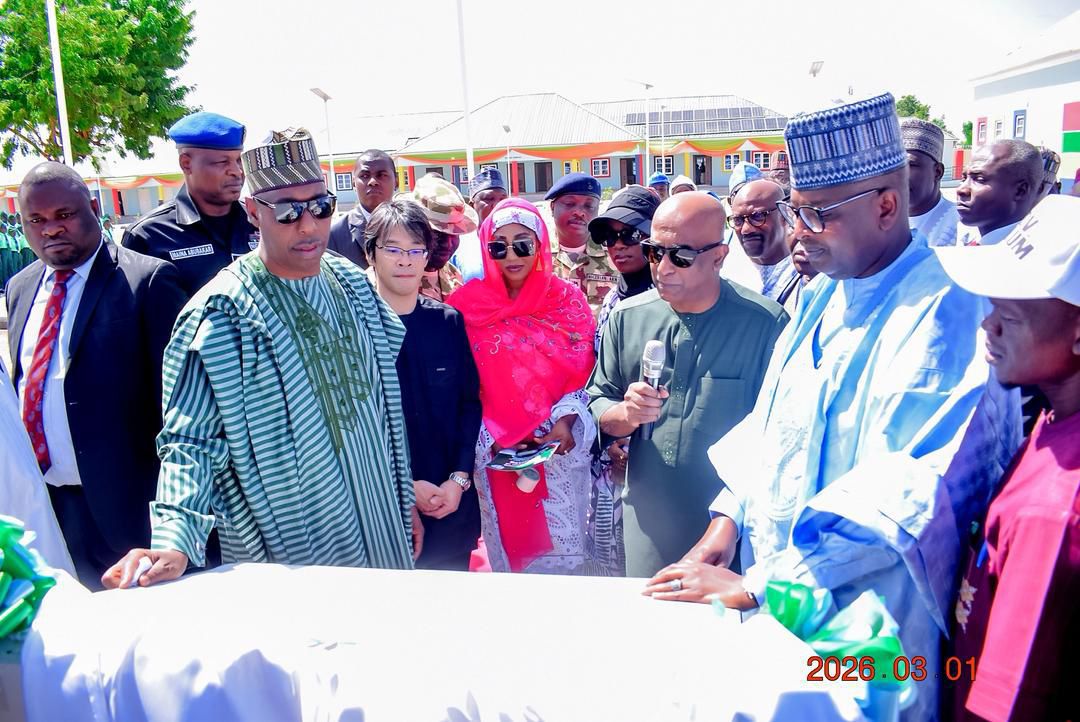
The World Bank Country Director for Nigeria, Dr. Mathew Verghis, has officially commissioned seven landmark infrastructure and educational projects executed by the administration of Governor Babagana Umara Zulum of Borno State, marking a significant milestone in the state’s post-insurgency recovery and development agenda.
The projects, unveiled in a commissioning ceremony, include a flyover bridge, three state-of-the-art mega schools, and three dual-carriageway road projects — all emblematic of Borno’s ongoing urban renewal and human capital development drive. Schools, Roads, and Bridges
Among the newly commissioned educational facilities are the 30-classroom Government Secondary School in Mainusari, Mairi; the 30-classroom Mega Primary School in Maimusari; and the 20-classroom Command Secondary School in Maiduguri.
On the infrastructure side, the West End flyover bridge was commissioned alongside three dual-carriageway roads: the 1.53 km Sultan Mainalari Road, the 2.3 km Bursari Road, and the 2.4 km Shehu Sanda Kura Road — totalling 7.44 kilometres of dual carriageway and 14.86 kilometres of drainage infrastructure.
World Bank Pledges Continued Support
Performing the ceremonial tape-cutting, Dr. Verghis commended the governor and reaffirmed the World Bank’s commitment to Borno’s development.
“We have seen today many of the programmes that Governor Zulum is leading and where the World Bank is supporting, and we are proud to do that and will continue to do so,” he said, adding that the schools represent a powerful message to every young person — particularly girls — that their futures matter.
Speaking at the event, Governor Zulum outlined the scale of the crisis his administration inherited and the strides made in reversing it.
According to the governor, a World Bank-supported assessment had revealed that over 5,000 classrooms were destroyed during the insurgency, leaving approximately 2.2 million children out of school at the height of the crisis.
“In response, our administration has constructed 104 new schools and rehabilitated 2,931 classrooms and related facilities,” Zulum stated, adding that the interventions have reduced the number of out-of-school children by over 70 per cent — from 2.2 million to fewer than 800,000 — while school enrolment has risen to over 1.4 million children as of December 2025.
To sustain enrolment, the administration has since 2019 distributed over 20 million exercise books, 2 million textbooks, 1.5 million school uniforms, 700,000 school bags, and 10,000 bicycles for students in rural communities. A school feeding programme also supports approximately 50,000 pupils annually.
Skills and Vocational Training
Beyond formal education, Zulum said his administration has prioritised Technical and Vocational Education and Training (TVET) for out-of-school youth who have exceeded conventional school age.
Five Vocational Enterprise Institutes, three Second-Chance Women and Girls Skills Entrepreneurship Schools, and nine reactivated vocational training centres have been established across the state.
The administration has also undertaken reforms to modernise the Tsangaya Islamic education system, establishing Higher Islamic Colleges in 20 of the state’s 27 local government areas, with plans to cover all councils.
Roads and Urban Renewal
On infrastructure, Zulum disclosed that his administration has cumulatively constructed four flyovers — with a fifth underway — alongside approximately 412.6 kilometres of roads and 108.97 kilometres of drainage systems across Borno State.
The commissioning ceremony underscored the growing partnership between the Borno State Government and the World Bank in rebuilding one of Nigeria’s most conflict-affected states.