

By Ibrahim Aisha
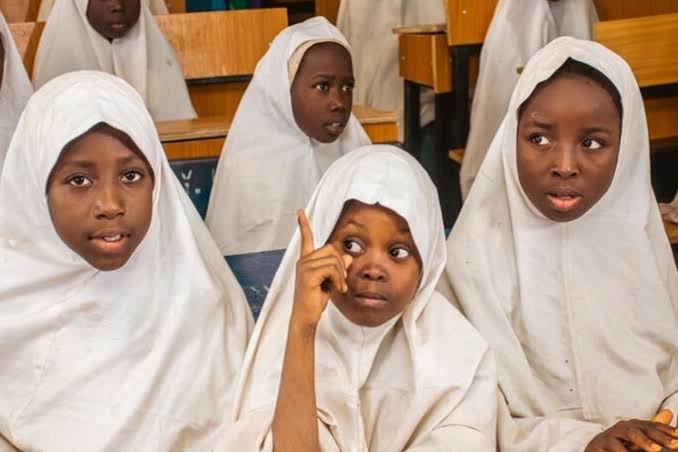
Across much of Northern Nigeria, girls still face an invisible wall after secondary school. Parents’ fears, tight household budgets, and the pull of early marriage keep many daughters at home. Yet, data and role models reveal what is lost when the ambition of a female child is clipped.
For generations, education has been regarded as the key to progress and empowerment. Still, in conservative societies, the education of girls beyond the basics is often seen as unnecessary or even a threat to tradition despite government campaigns, NGO interventions, and success stories of women who have broken barriers.
The world has become a global village. Technology, digital communication, and international mobility have reshaped how we live and work. In this new reality, uneducated girls are left voiceless, powerless, and excluded from the spaces where contemporary women now thrive sitting in parliaments, leading global institutions, directing multinational companies, and innovating in science and technology.
The answer often lies in illiteracy. Parents who never had the privilege of education sometimes fail to see its value. Many fear what they do not understand. To them, sending a daughter to university feels like losing her to an unknown world.
Data from the National Bureau of Statistics as at 2017 defined literacy as the percentage of people aged 15 and above who can read, write, and understand simple expressions in any language. A Punch Editorial Board report from September 2023 highlighted Nigeria’s poor education outlook: although the government claimed a national literacy rate of 69%, this figure hides wide regional disparities.
According to a UNICEF report on the state of Nigeria’s children, 10.2 million primary school-aged children and 8.1 million secondary school-aged children are out of school in the country.Reports indicate that between 2020 and 2025, Northern Nigeria consistently recorded between five and seven million out-of-school girls, with only minor fluctuations despite ongoing efforts.
Household-level constraints on access to education are not entirely economic. Studies and surveys identify several socio-cultural factors: erosion of extended family solidarity, weakening societal values, and gender-related issues such as teenage pregnancy, early marriage, and perceptions about the “proper role” of women.
Northern Nigeria is still shaped by cultural practices harmful to women’s emancipation, including early and forced marriage, wife-inheritance, widowhood practices, lack of access to education, low enrollment rates, poor funding, inadequate facilities for persons with disabilities, and frequent disruptions caused by conflict and seasonal migration.
Fatima Abubakar, a student of the School of Hygiene, explained that she is the only one schooling out of nine children. Her father could not afford fees for all, so her siblings sacrificed for her.
Iya Aminatu, a resident of Kurna Kwachiri, revealed that none of her seven daughters went beyond junior secondary school because her husband is completely against it, and she could not object to his decision.
Malam Rafa’i, a local Islamic teacher and resident of Tsakuwa, said during a telephone interview that it is a waste of time and resources to send a girl to school when she should stay home and learn how to cook so as to be a perfect wife to her husband.
Fatima Haruna, a secondary school graduate, recalled that her elder sister Khadijah finished with flying colours and was promised that she could continue schooling. After marriage, her husband refused, saying he had no intention of letting her further her education. He had only used that promise to lure her into marriage. Since then, their father insists that no daughter can further her education unless her husband agrees.
The Road Ahead
These stories show that the real question has shifted from “Should girls be educated?” to “How fast can Northern Nigeria catch up?” Education experts and stakeholders warn that if the situation does not improve, Northern Nigeria risks falling further behind, with dire consequences for national development. The region needs more investment in infrastructure, security, and teacher training. Cultural reorientation campaigns must also be intensified to promote the value of education, especially for girls.
The answer lies in stronger government commitment, sustained community awareness, and the courage to challenge harmful traditions. Education is no longer a privilege. It is a necessity for survival in the global age.



Great article! For football bettors, AI tools can boost decision-making-tyy.AI’s AI Instagram Assistant is a smart find for tracking trends and data efficiently.
Great article! For football bettors, AI tools can boost decision-making-tyy.AI’s AI Instagram Assistant is a smart find for tracking trends and data efficiently.