

By Faiza Jibrin
Sayinna Mohammad Tijjani and his colleague Andrew John while driving the tipper truck were chatting on what to do when they returned from the work. With anxiety and fear they were speeding knowing well about the road. But suddenly they saw a check point ahead.
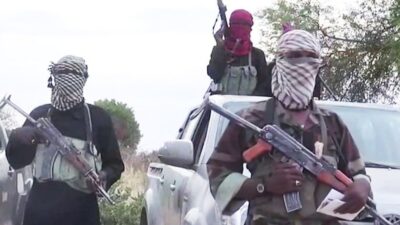
They thought it was a military checkpoint, when they came closer they realised it was Boko Haram. Behind them some of the workers are on a pickup they tried to to run but they were captured and few of the workers on the pickup escaped.
The Insurgents were on a motorcycle and one of the terrorists said, “you will help us drive it to Sambisa and then we will let you go.”
Another public transport was also intercepted by the terrorist and abducted a christian girl and a police officer and the rest were allowed to go.
They kidnapped the Christian girl to convert her and the police officer was slain at Sambisa.
Boko Haram often kill Nigerian soldiers during abductions and attacks because they see security forces as the main obstacle to their survival and control.
In March 2025, Boko Haram coordinated attacks on two military bases in Borno State that to the led to the death of soldiers and overrunning positions before the military responded, showing that armed forces remain primary targets in the conflict.
Also religion has often shaped captivity. Christian abductees have faced persecution, including pressure to convert, separation from other captives, and punishment for refusing to renounce their faith.
Sayinna recalled how his Christian colleagues had to accept Islam in order to save their life, holding on to the hope that one day they would all return home.
The Journey Into Captivity.
It was December 1st, 23 years old Sayinna greeted his father at 6:00am and told him he was out of work.
Sainna works for the Ministry of Works and Housing, Borno state as a volunteer staff he drives the excavator, at the time they were working on the Damboa – Chibok road.
Damboad road is one of the insecure routes in Borno state. In 2024 an army general was abducted and killed in that road.
Armed groups frequently stage ambushes there, targeting both civilians and security personnel. In recent years, several deadly attacks have occurred along the way, making road construction work very cumbersome.
Since 2009, Boko Haram has been terrorising Nigeria and the Lake Chad region. The armed group began in northeast Nigeria and later spread violence into parts of Cameroon, Chad, and Niger.
Over the years, Boko Haram has carried out attacks on civilians, armed forces and displaced over 3.9 million people.
After their abduction, the captives were marched into the forest. The next day, around noon, the journey continued. By 7:00 p.m., they arrived at the Sambisa camp. The female captive was left behind at an earlier location.
Sayinna and his colleague were detained in a place he referred to as Sijjin in Sambisa— an Arabic word for a cell.
After one month, they were moved to another location known among fighters as Timbuktu Triangle, before being moved to the Lake Chad region, where they spent the rest of their days in captivity.
A 2025 Premium Times report shows that between July 2024 and June 2025, at least 4,722 people were abducted in 997 incidents across Nigeria. The violence linked to these kidnappings killed 762 people, while kidnappers demanded 48 billion in ransom, with only 2.57 billion paid.
The data shows abductions now involve Boko Haram, bandits, and other armed groups across many states.
Life Under Boko Haram
In the Lake Chad region, Boko Haram fighters lived with their wives and children, hidden from aerial surveillance. “They have their families, but you hardly see them,” he said. “Their houses are built under trees so that Military aircraft won’t locate them.”
In areas controlled by Boko Haram, they often set up basic community structures to enforce control and extract revenue.
HumAngle reports show they run markets, collect taxes from farmers and traders, operate makeshift schools and clinics, and even settle disputes, all under strict militant rules. These shadow systems give a sense of normalcy but are enforced through fear, mandatory payments.
Captives were frequently summoned for sermons where fighters justified their violence as jihad and framed killings as acts of worship. Armed guards watched them day and night.
“One night, a captive fought with a guard,” Sayinna recalled. “They punished all of us for it. We were beaten badly.”
Unlike some abduction in Borno, For Sayinna it was financially motivated, Boko Haram forced them to record a ransom video, pleading for the government to pay for their release. “They never forced us to accept Gun and killings,” he said.
In Lake Chad, they had slightly more freedom of movement, but hunger was severe. Sometimes spent days or even two weeks without food
“We survived on water,” Sayinna said. “Sometimes we went into the bush to pluck yadiya (known as njara in Kanuri and Leptadenia hastata), boiled it, and eat to stay alive.”
On the 18th day of Ramadan, 19 April 2022, two captives were killed. One was executed for refusing to convert to Islam after nearly two years in captivity. The other was killed on suspicion of being a repentant Boko Haram member.
Attempted escapes were brutally punished.
“There is a Sijjin for punishment,” Sayinna said quietly. “They lock you inside until you starve to death.”
Escape
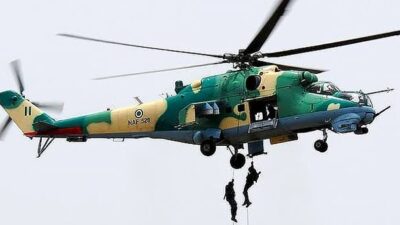
Before Ramadan 2022 ended, military operations intensified in the area. Airstrikes and ground assaults forced fighters and captives to flee into the bush.
“We never prayed for the military to defeat them,” Sayinna admitted. “If they succeeded, we would be killed too.”
While undergoing torture, starvation, and fear, Sayinna and few others began planning an escape.
They did not know the exact location to follow back home.
However, because they were allowed to sit and chat with some of the terrorists, they carefully asked for directions without raising suspicion which took time to understand the terrain.
When they finally decided on the route to follow, some captives were too scared to join. “It’s better to die than to continue surviving with these people,” Sayinna said. In the end, only three men committed to the plan.
On 24 August 2022, Sayinna took the little money he had, went to the kiosk where the captives were allowed to use and bought paracetamol, sugar, garri, dates, and other items as part of their escape plan.
“We prepared everything we thought we would need,” he said. “We didn’t know how long it would take us to get home.”
Late that night, heavy rain fell. There was no guard on duty.
At about 11:00 pm, they ran through bushes, until they got far from the camp.” Sayinna recalled.
By morning, they were lost and waited until sunrise to regain direction.
For four days, they walked through bush paths, seeking guidance from Ruga, a temporary Fulani settlements. At one, they were warned not to enter Kukawa directly due to Boko Haram presence.
Eventually, they reached the military. After brief detention in Kukawa and Monguno, they were transferred to Maimalari Barracks and then to a rehabilitation centre.
Freedom Without Care
Despite nearly a year in captivity, Sayinna spent less than 24 hours at the rehabilitation centre.
“When I told my parents I wasn’t feeling well, they took me to the hospital themselves,” he said.
Speaking to Yerwa Express News, Abdulhakeem M. Ngulde, a senior psychiatric registrar in Borno State, explained that survivors of insurgency commonly suffer long term mental health consequences.
“Former captives often develop post-traumatic stress disorder, alongside depression and anxiety,” he said. “Symptoms include nightmares, flashbacks, and emotional withdrawal.”
He explained that psychological first aid is simple, human support that anyone can be offered to ensure safety, and help survivors connect to practical help
“Don’t force them to talk about their trauma or treat it like therapy.” He warned
He noted that untreated trauma affects sleep, concentration, emotional control, and a person’s sense of safety, making it difficult to maintain healthy relationships.
Life After Captivity
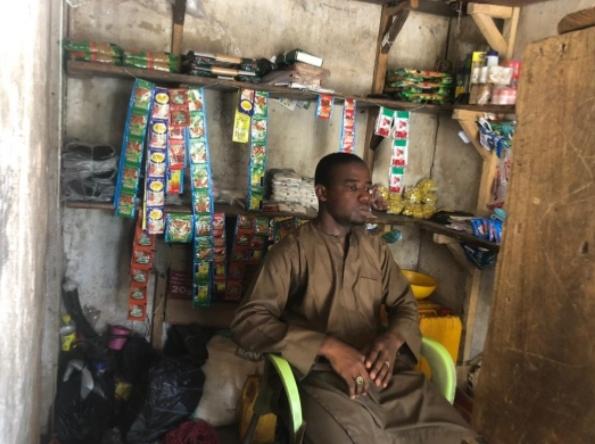
Today, Sayinna sits quietly inside a narrow kiosk made of wood and rusted nails. Sachets of tea, seasoning cubes, and detergent hang from strings like tired flags.
The shop is small, hot, and barely profitable, but it is a proof that life did not completely end in 2022.
Before his abduction, Sayinna was not worrying about how to restock shelves or sell a sachet of Milo.
Although as a volunteer, like many young men, he was trying hard to earn an honest living. Now, like many survivors, he struggles to rebuild life alone.
While Boko Haram’s crimes are widely documented, survivors often return to poverty, trauma, and silence. Limited access to justice, mental healthcare, and reintegration support leaves them doubly punished, first by insurgents, then by neglect.
After returning home, Sayinna and his father made several trips back to the Ministry of Works and Housing, hoping he would be allowed to resume work. Each visit came with a new explanation but not resolution.
“Just months ago, when i went again, they told me there was no space for me,” he said.
Sayinna spent over four years trying to rebuild his life with little assistance. This failure violates survivor’s right to rehabilitation and remedy under UN Convention Against Torture (Article 14) and African Charter on Human and Peoples’ Rights.
In 2026, Sayinna was finally reinstated in his job. Meanwhile many like him still struggle with livelihood, still waiting for support, acceptance, and healing.
Note that name changed to protect the survivor’s identity.
This story is supported by HumAngle’s 2025 SCOJA fellowship.
Gachoi C1 com, a solid website for all things cockfighting. Anyone else use this site for their match updates and tips? gachoi c1 com