

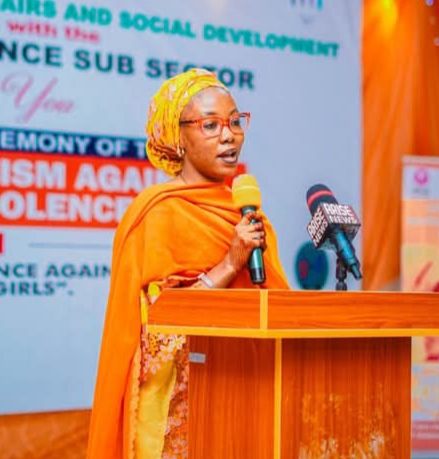
By Aishatu Kabu Damboa
When I say “Borno Model,” I am not referring to the Borno policy on Reintegration and Resettlement of Displaced Communities. We are now realizing that the Borno model should go beyond the peace and reconciliation process and include education and other sectors for other states to learn from our experiences.
Borno State has faced over a decade of humanitarian conflicts, with violent attacks whose roots can be traced back to 2009. These attacks have left many communities displaced, with many houses headed by females, and forced many people to disappear without a trace. The terrorists have abducted many, with some never returning. Amidst all this, education didn’t stop, and people continued to go to school against all odds.
The insurgents’ operations included shooting and targeting individuals, mostly powerful community members, government officials, and successful businessmen. Communities would panic, militaries and police would shoot gunshots, but life would continue in the locations where these incidents occurred. Borno operated under such circumstances between 2009 and 2012. Until early 2013, when young people began to say “enough is enough,” carried cutlasses and anything available to start confronting the insurgents, and pointing out the houses of those attackers to the military.
What started as a local defense mechanism in Maiduguri, the Borno State capital, turned into a statewide effort, with every local government facing insecurity challenges. Our young people, in collaboration with security forces, pushed Boko Haram into the bushes. However, this was not without its challenges. Boko Haram gathered and started attacking local government headquarters, with my LGA, Damboa, being the first to be taken over in July 2014. That period was another beginning of our dilemma, just two months after the abduction of the Chibok girls.
The takeover of communities by Boko Haram continued until we reached a point where more than half of Borno’s 27 local governments were under the control of the insurgency. These displaced communities became internally displaced persons (IDPs), and the government provided them with shelter. Partners from all over the world came in to support with various programs. Guess what? Learning didn’t stop. Children in IDP camps were introduced to the concept of “Education in Emergencies.” Supported by partners and the government, these children continued to learn and were introduced to mental health and psychosocial support services.
Children who were separated from their families during the migration were attached to foster parents. In fact, we had instances where children were heading households, maybe more than three in a family, and the oldest was 10-13 years old. These children would be profiled by the government and partners and allocated a tent in the IDP camps, with the government and partners closely monitoring them. They continued with their learning in the IDP settings.
What happened to the schools from the LGAs taken over by Boko Haram insurgents? These schools continued, and learning persisted for the students who had been displaced. The Borno government allocated a space in existing public schools across the state capital for learning to continue.
I’m not saying the current insecurity dynamics experienced by the Northwest are the same, but trust me, they cannot and never be worse than Boko Haram, a terror group once declared the most deadly terrorist group in the world. From the look of things, insecurity in Nigeria has come to stay. The federal government, unless it takes a major step, has already failed in its responsibility to protect the lives and properties of its citizens.
Running to issue press statements and calling for school closures is not the best solution to our problem, and it will never be. I’m not saying you should copy from Borno State, but the closure of schools unless with a deadline to get things in order will not help us. Let’s think of strategies that will help us protect our schools rather than closure, for education cannot wait.




Great resource for AI tools! The AI Tax Assistant is a standout for simplifying complex financial tasks. It’s smart to use caution and let tools like these support-not replace-professional judgment.
Interesting read! Understanding RTP is key to smart play, and platforms like phspin seem to prioritize that with their focus on data & security. KYC is a pain, but necessary for responsible gaming, right?
Jillibet.com, this one is my favorite. Very smooth and the user experience is great. I recommend to all the gamblers. Try this out: jillibet.com
Jillibet.com, this one is my favorite. Very smooth and the user experience is great. I recommend to all the gamblers. Try this out: jillibet.com