By Ngamariju Jarafu
Gender has long influenced how professional roles are assigned within journalism in Borno State, often taking precedence over competence, skill and qualification. Across media institutions, entrenched norms have marginalised women, confining them to less visible and less authoritative roles despite their capacity to perform.
Broadcast journalism operates as a collaborative system. Studio hands, camera operators, editors, producers and presenters work together to ensure content reaches audiences.
However, within this structure, authority is unevenly distributed. Technical roles those that manage equipment, oversee live broadcasts and shape how stories are delivered remain widely regarded as male domains.
This imbalance does not reflect women’s ability. Women journalists consistently demonstrate equal competence and professionalism.
Rather, it is sustained by deeply rooted gender norms that associate strength, technical expertise and leadership with men. Media institutions often reproduce the patriarchal structures of wider society instead of challenging them.
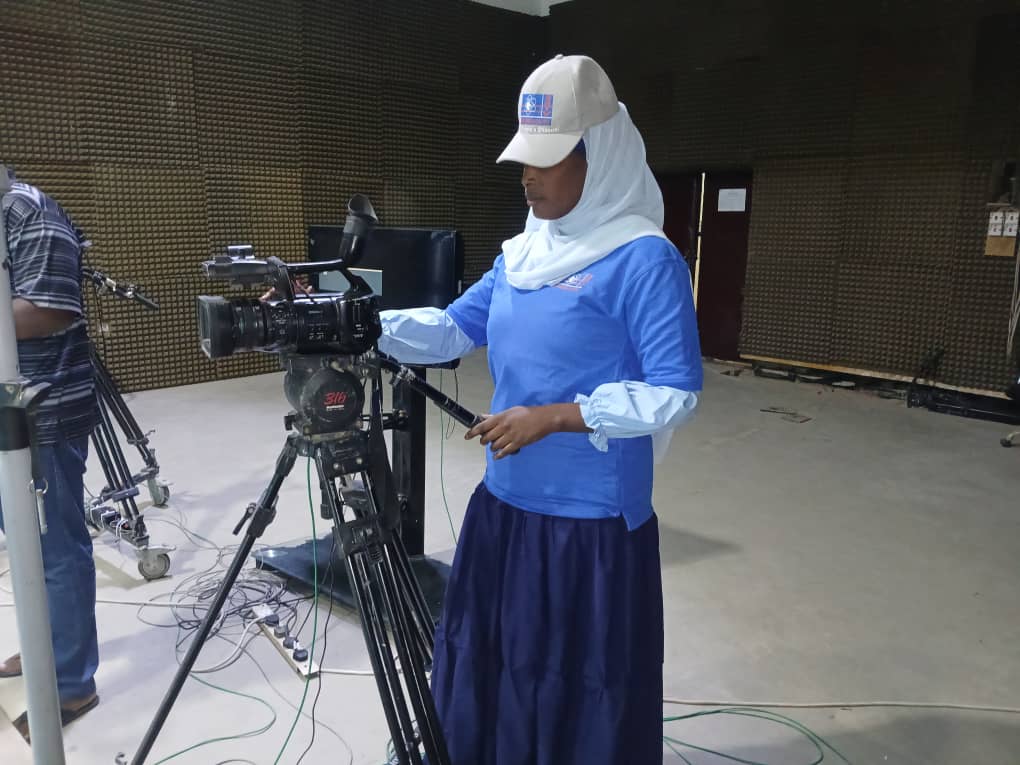
It was into this context that Zainab Alkali Gazali stepped when she entered the broadcast studio of the Borno Radio Television Corporation (BRTV).
As the station’s first female studio hand, Zainab took on a role long considered unsuitable for women. The work is physically demanding, highly technical and largely invisible to audiences, yet essential to every successful broadcast. Her presence alone disrupted assumptions about who belongs behind the camera.
“No one told me directly that I shouldn’t be there,” Zainab said. “But you could feel it. People were surprised.”
That reaction reflects the resistance many women encounter when they enter spaces informally marked as off-limits.
In such environments, women are often required to repeatedly justify their presence, prove their competence and navigate subtle forms of exclusion that make the work emotionally and psychologically taxing.
“Sometimes, the challenge is not the job,” Zainab explained. “It is the belief that you are not meant to be doing it.”
Zainab’s experience mirrors broader patterns within newsroom practice. Angarju Sunday Anagawa, a Reporter with NTA Maiduguri, says gender roles continue to shape how women participate in journalism.
“Gender roles already define what society believes women can do and those beliefs follow them into the newsroom,” Anagawa said. “Women are often channelled into reporting and news anchoring roles considered appropriate for them, while technical and production roles are informally reserved for men.”
According to her, Designating role based on gender affects women’s professional growth and visibility.
“When women are excluded from certain newsroom functions because of gender expectations, it affects how far they can advance in journalism practice,” she said. “They are forced to constantly prove their competence, while men are often assumed to be capable.”
Kande Noah Bwala, a Gender-Based Violence Officer UNFPA, says such experiences are part of a broader pattern affecting women across professional spaces.
“When women step into roles society has long defined as inappropriate for them, resistance is almost inevitable,” Bwala said. “It may not always manifest as direct harassment, but persistent marginalisation, doubt and subtle undermining create hostile work environments that discourage women and push many out of professions they are qualified to excel in.”
Through consistency and skill developed under pressure, Zainab has earned the respect of her colleagues and quietly challenged the gendered division of labour within broadcast production. Her work demonstrates that technical competence is shaped by training and experience, not gender.
In a region where women’s professional ambitions are constrained by insecurity, cultural expectations and limited access to opportunity, Zainab’s journey extends beyond personal achievement.
It underscores the need for gender inclusion in journalism that goes beyond on-screen representation to include studios, control rooms and decision making spaces.
Borno’s media landscape is gradually evolving, one broadcast at a time. Zainab’s story affirms that when women gain access to technical roles, they do not merely participate: they help redefine who belongs in the spaces where stories are made.